Thursday, Oct. 22, 2026
When someone asks where your agent got that number

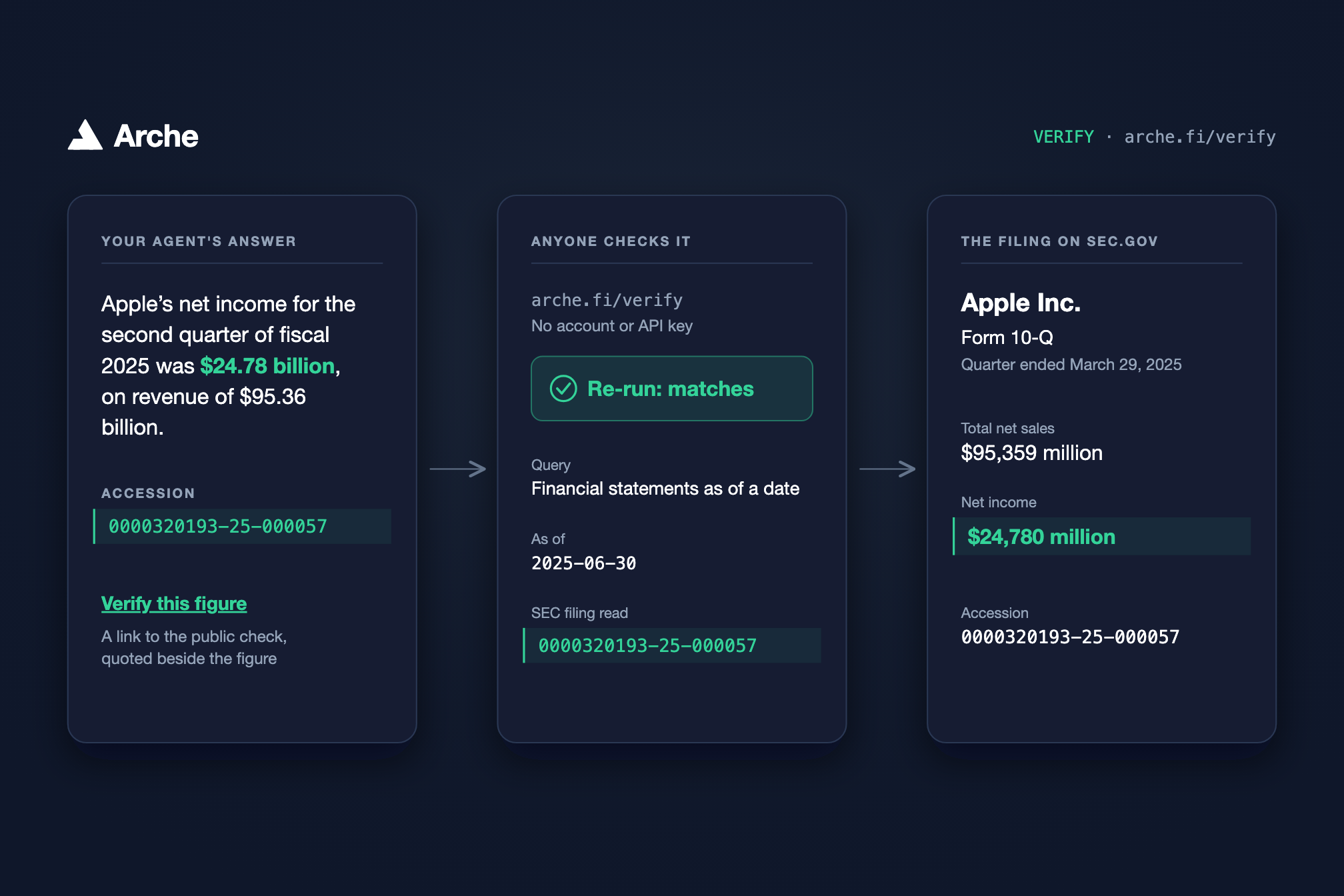
Your agent tells a customer that Apple earned $24.78 billion in the second quarter of fiscal 2025. Sooner or later someone asks where that number came from, whether it is the customer or their compliance team a year later.
Your company owns the answer, and the errors models make with filings are hard to see: the right figure from the wrong quarter, or the right line from another company. In Fin-RATE, a benchmark of 17 models on SEC filings, accuracy dropped by 18.6% when tasks moved from a single filing to tracking a company across reporting periods. For broker-dealers, FINRA’s 2026 oversight report suggests that firms using generative AI store prompt and output logs and test the tools for accuracy.
Arche gives your agent a link to quote beside each figure. Whoever you hand it to can open it without an Arche account and see the filing the figure came from, along with Arche’s record of the result it served your agent.
A token beside each figure
Arche’s MCP as-of tools, financials_get_as_of_snapshot and provenance_as_of, return a replay_token and a verify_url with each page of statements. The token names one query at one point in time and the exact result Arche returned for it. Code that calls the REST API gets the same token from POST /v1/query/execute.
A line in the system prompt is enough to have an agent pass it on:
When you quote a figure from Arche, give its accession number and the verify_url from the same result.The answer then reads like this:
Apple's net income for the second quarter of fiscal 2025 was $24.78 billion,
on revenue of $95.36 billion (accession 0000320193-25-000057).
Verify: https://arche.fi/verify/54d5dccb14683698b4e9c911e233d24fb768409502f20e023b80aa7883150bcd
Checking takes no account
Your user opens the link. Arche runs the original query again, at the original date, and compares the result with the one it recorded when it issued the token. The page needs no sign-up and no API key, and neither does the route behind it:
curl "https://api.arche.fi/v1/query/verify/54d5dccb14683698b4e9c911e233d24fb768409502f20e023b80aa7883150bcd"The page shows a verdict and the accession number of every filing the answer drew on, each linked to the filing on sec.gov. Your user can set the agent’s figures beside the document Apple filed. Both result hashes, from when the token was issued and from the check, are shown as well.
When the query returns the same statements and values it returned when the token was issued, the verdict is MATCHES.
The response does not include the figures, so your user can forward a token to an auditor without passing on Arche data. Anyone whose Arche plan covers the company can read the original figures back with GET /v1/query/replay/{replay_token}.
One agent checking another
The replay_verify MCP tool runs the same check from inside an agent. It takes a token and returns the verdict, the query, the hashes and the accessions. A reviewing agent can check a drafting agent’s figures before a report goes out, or an agent can confirm a token before quoting it.
Try it
Replay tokens, the replay_verify tool and the verify page come with every plan, including Free. Connecting the MCP server to Claude Code takes one command:
claude mcp add --transport http arche https://api.arche.fi/mcp \
  --header "X-Api-Key: YOUR_API_KEY"
The Free plan is for building and testing; showing Arche figures to your customers takes a paid plan. Get a free API key, or paste a token you already have into arche.fi/verify. The guide to verifiable agent answers explains what a token covers when results are paged or queried by timestamp.