Monday, Oct. 12, 2026
We tested point-in-time data providers on seven 2026 restatements

Arche serves SEC financial statements as they stood on any date, with the filing behind every figure. It is built for people who have to show where a number came from and when it was public. Below are results of a test we ran on seven restatements to highlight how Arche fits among data providers.
Who needs figures as of a date
An AI agent answering a question about a company should cite the filing a figure came from, and the figure should be the one that was public on the date the question is about. If it isn't, the agent is quoting a number nobody had yet.
An application that shows fundamentals to its own users has to explain why a figure changed. When a company files a 10-K/A, the user sees a different number and asks why.
Audit, research and model review need to show what data was used, sometimes months later. Saying the figures came from a vendor isn't enough if the vendor has since replaced them.
Backtests have the same problem. A backtest that reads restated figures for the months before the restatement is trading on numbers the market didn't have.
Where Arche sits
Institutional platforms have sold point-in-time fundamentals for decades, through sales teams and with prices on request. Developer APIs are self-serve with published prices, and many of them keep only the latest figures for each period. Arche is a self-serve API, with published prices and a Free plan, that keeps each 10-K and 10-K/A as filed and answers as of any date.
Arche is for work where you have to show which filing a figure came from, and prove later what you read.
The test
Plenty of providers say they serve figures as they stood on a past date. We checked that claim on seven restatements filed this year.
We picked seven companies whose FY2025 10-K/A changed revenue or net income. For each one we asked for the FY2025 income statement twice: as of the day before the 10-K/A was filed, and as of the day after. The day before should return the original 10-K figure, and the day after the 10-K/A figure. Both filings are on EDGAR, so anyone can check which one came back.
| Company | Figure | Original 10-K | 10-K/A | 10-K/A filed | Days between filings |
|---|---|---|---|---|---|
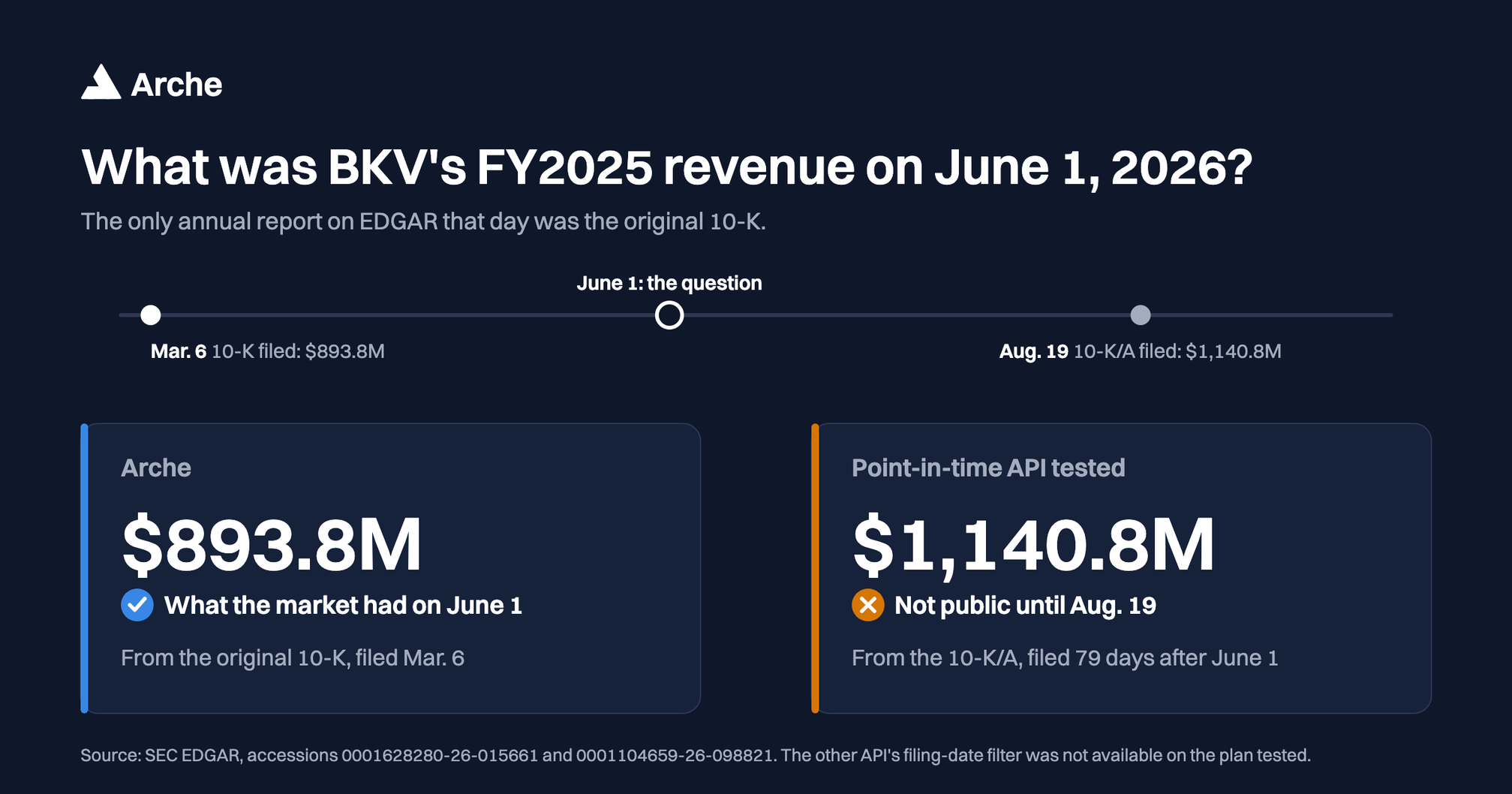
| BKV | Revenue | $893.8M | $1,140.8M | Aug. 19, 2026 | 166 |
| DCO | Net income | −$33.9M | −$37.4M | May 8, 2026 | 71 |
| NABL | Net income | −$17.0M | −$18.8M | Aug. 10, 2026 | 165 |
| BAFN | Net income | −$22.9M | −$24.6M | Aug. 12, 2026 | 138 |
| CRMZ | Net income | $1.02M | $0.51M | Aug. 19, 2026 | 148 |
| NCRA | Revenue | $13.6M | $11.0M | Aug. 28, 2026 | 135 |
| FDCT | Net income | $5.78M | $5.80M | July 1, 2026 | 75 |
On its Free plan, Arche returned the original figure the day before each amendment and the amended figure the day after, in all seven cases.
We ran the same companies through a developer API that advertises point-in-time data. It returned only the amended figure for all seven. Passing the original 10-K's accession number still returned the amendment. We used its entry-level plan, prepaid credits charged per request. That plan refused requests using its filing-date filter, so we could not test it. Ask that API today for BKV's FY2025 revenue and you get $1,140.8M. From March 6 to Aug. 19, the only annual report on EDGAR said $893.8M, and on the plan we tested we found no way to get that figure back.
Proving the answer later
Every value Arche serves names the filing it was read from and the XBRL concept behind it, so an agent's answer can cite the accession number and a reader can open the filing. Each as-of response carries a snapshot hash. Ask the same question again and the hash is the same. Queries run through the query endpoint return a replay token, which a reviewer can hand back to Arche to rerun the query and confirm the result still matches.
When a company restates, Arche records which lines changed, the old and new values, and the effect on ratios such as the current ratio. It can post that to your endpoint as a signed webhook, so you find out the day a figure you cited changes.
Try it
The Free plan covers any 25 companies, enough to repeat the test. Here is BKV on the day before and the day after its 10-K/A:
for d in 2026-08-18 2026-08-20; do
  curl -s -H "X-Api-Key: $ARCHE_API_KEY" \
    "https://api.arche.fi/v1/edgar/as-of/$d/financials/BKV" |
  jq -c '.data.statements[]
    | select(.statement_type=="INCOME_STATEMENT" and .fiscal_year==2025 and .fiscal_period=="FY")
    | {filing_type, accession_id, filing_date, revenue: .values.REVENUE}'
done
{"filing_type":"10-K","accession_id":"0001628280-26-015661","filing_date":"2026-03-06","revenue":"893781000"}
{"filing_type":"10-K/A","accession_id":"0001104659-26-098821","filing_date":"2026-08-19","revenue":"1140773000"}To test another provider, find a company that filed a 10-K/A changing a reported figure, ask the provider for that year as of a date between the two filings, and compare the answer with the original 10-K. A filing date on each row doesn't settle it: a provider can date every row and still keep only the latest filing for each period.