Monday, September 28, 2026
Arche Is Now Publicly Available

Arche is a developer-first API for deterministic, versioned, point-in-time financial fundamentals from SEC EDGAR filings. It covers 17,000 U.S. companies from 2009 to today. As of today it is open to everyone, with a free plan that needs no credit card.
Why Arche exists
Financial datasets overwrite history. When a company restates, the corrected figure replaces the original, and the original stops being retrievable. The SEC's own aggregated company facts API works the same way: ask it what a company reported for a period and you get one answer, the current one.
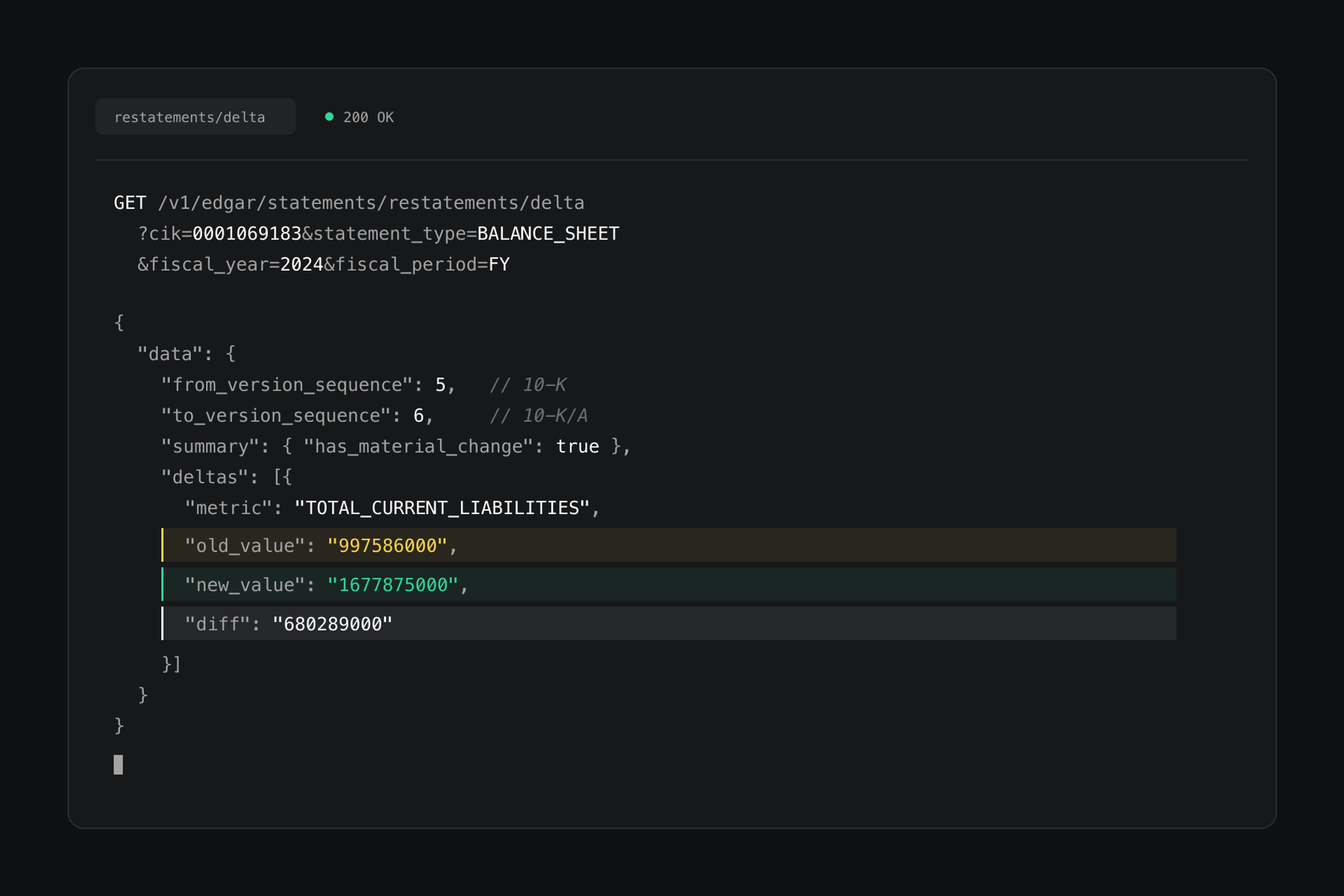
On February 28, 2025, Axon Enterprise reported total current liabilities of $997,586,000 for fiscal 2024, giving working capital of $1.300B and a current ratio of 2.30x. On May 7 it filed an amendment moving $680,289,000 of convertible notes from long-term into current. The same line became $1,677,875,000, working capital fell to $619.606M, and the current ratio dropped to 1.37x. Nobody had made an error. A liability moved one line up the balance sheet.
Both figures are correct as filed. A dataset that holds only the second one cannot answer what your model saw in March, which means a backtest you ran then cannot be reproduced now, and nothing in the data indicates that an input changed.
Arche holds both versions, the filing behind each, and the difference between them.
Versioned statements with full lineage
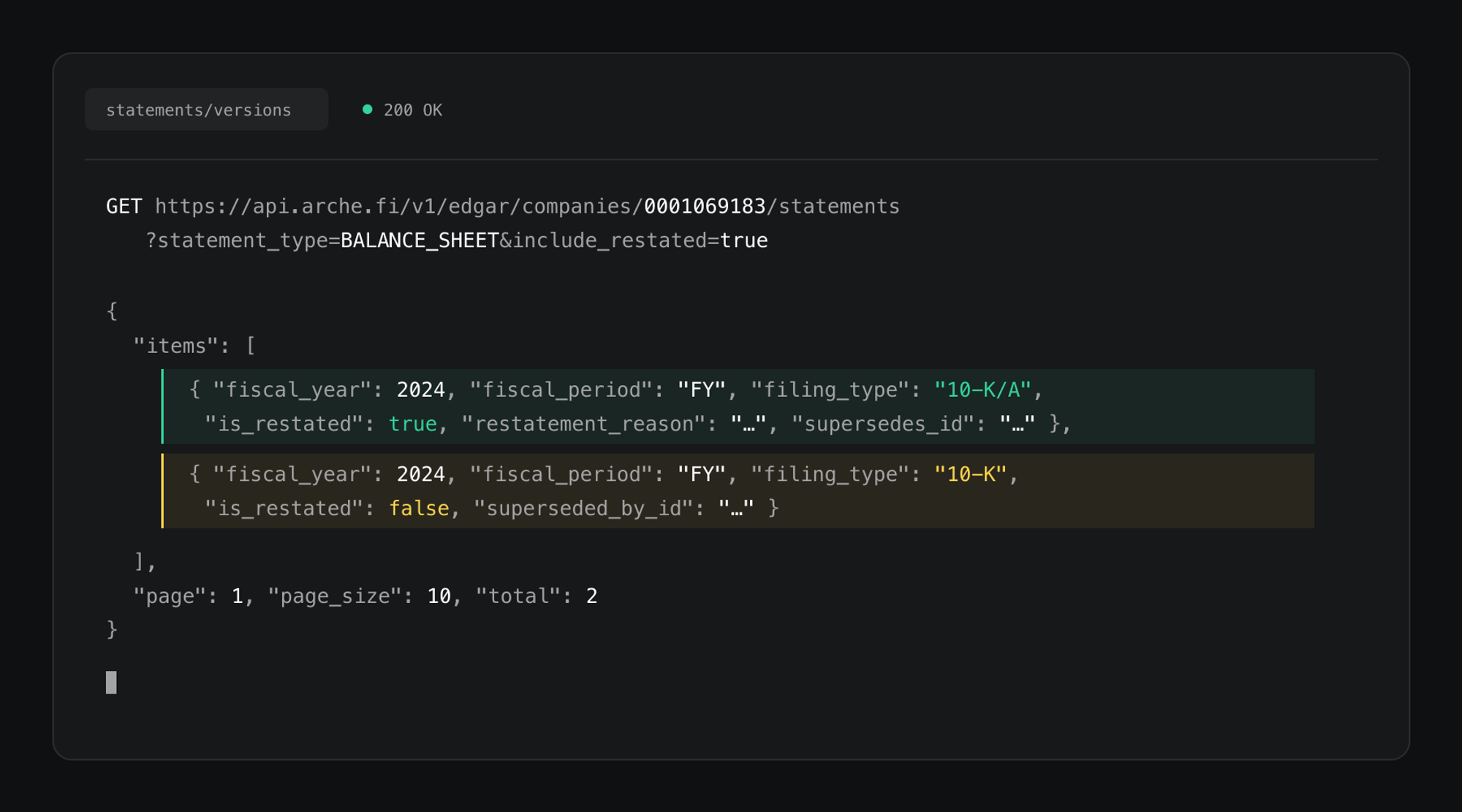
Every statement version is addressable and carries its own provenance: accession_id, filing_type, filing_date, and accepted_at. Lineage is explicit. A version that restates an earlier one carries is_restated, a restatement_reason, and supersedes_id; the version it replaced carries superseded_by_id. Requests return the current version by default, and include_restated=true returns the whole chain.
Point-in-time queries and deterministic replay
Ask for a company's financials as of a date and you get statements built only from filings the SEC had accepted by then. Each snapshot is fingerprinted with a hash over the exact versions it selected.
Every query returns a replay token. Send that token to a colleague and they re-run the same query against the same versions and get the same answer, rather than their reconstruction of it. When the answer has changed, both hashes come back so the difference is visible rather than argued about. Replay is included on every plan, the free one included.
Verification against the filing, before publication
Before a statement is published, every value taken from a filing is checked against what that filing reported for the same line and the same period. A value that contradicts its filing is quarantined and never enters the dataset.
The check runs against the filing's own facts rather than against an aggregate, because an aggregate no longer holds the superseded figures that as-filed history consists of. The gate is enforced in the database: a version cannot be published without a payload, published versions cannot be edited, and the evidence tables refuse updates at the storage layer.
Reported and derived values are distinguishable
Some lines on a normalized statement are stated by the filer and some are arrived at, such as gross profit from revenue and cost of revenue, or equity from assets and liabilities. Arche marks each value as reported or derived, and a derived value names the rule that produced it. You can filter to only what the company itself stated, and see the arithmetic behind the rest. Where a filer reported a subtotal as nil, Arche does not substitute a zero the filer never stated.
Restatements are pushed to you
When an amending filing is normalized, Arche posts a restatement.detected event to your endpoint, signed with HMAC-SHA256 in an X-Arche-Signature header, deduplicated per subscription and retried on a backoff schedule. The event names the statement and the version it supersedes, carries each changed metric with its old value, new value and delta, classifies the change, counts the material ones, and reports the downstream figures that moved with them. Restatement webhooks are available from the Developer plan.
Coverage that includes the companies that stopped reporting
Arche holds filings for 17,000 U.S. companies from 2009 to today, including registrants that were delisted, acquired, or taken private. A backtest run only on the survivors is biased in a direction that is invisible from inside it. Normalization handles 52-week and 53-week fiscal calendars, companies that change their year end, foreign filers reporting under IFRS, and filings presented in more than one currency.
Agents reach the same data through the MCP server on paid plans, which lets a model answer a question and name the accession numbers behind it.
Get started
The free plan is any 25 companies you choose, with no card and no expiry. You claim a company by querying it, and the slot stays yours as long as you keep using it, so you can test the contract against filers whose statements you already know. Paid plans open the full corpus and add MCP access and restatement webhooks.
Quickstart: docs.arche.fi/quickstart
Sign up: app.arche.fi/sign-up
Plans: arche.fi/pricing
Arche is built by Protos Systems. Tell us what you build with it: hello@protos.fi.